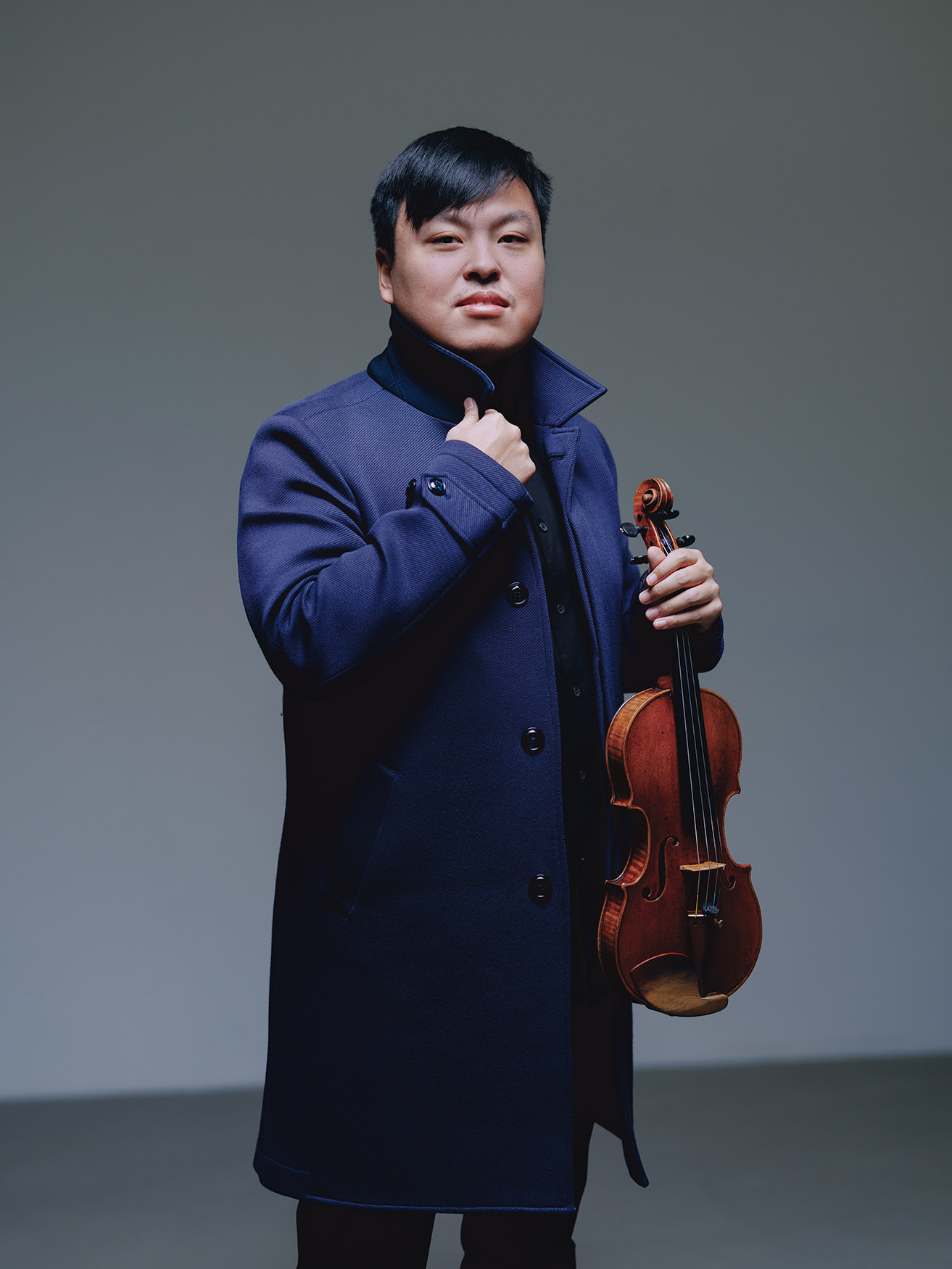
Luke is a much sought-after soloist and chamber musician. He is currently performing Paganini's complete 24 Caprices in concert halls across Europe and the US, where he has received rave reviews. He has performed as a soloist at Carnegie Hall, Wigmore Hall, Elbphilharmonie, Windsor Castle, Kennedy Center, Herkulessaal, Philharmonie Berlin, BOZAR, and many other venues. He has performed as a soloist with numerous renowned orchestras worldwide and has collaborated with leading conductors such as Leonard Slatkin, Pascal Verrot, Nikolaj Znaider, Hugh Wolff, Cristian Macelaru, and Jean-Jacques Kantarow.
In addition to his solo performances, Luke is a dedicated and passionate chamber musician. Together with four other musicians from Berlin, Luke co-founded Tonhain Kollektiv, a dynamic chamber music ensemble in Berlin. He is also co-founder of the Goethe Quartet. He has collaborated with renowned musicians such as Itamar Golan, Cho-Liang Lin, Gil Shaham, Marc-André Hamelin, Peter Frankl, and Colin Carr. He has performed at festivals such as Verbier, Gstaad, Presteigne, Romsey, La Jolla SummerFest, Wieniawski, Music@Menlo, and Yellow Barn. Luke is also a regular guest at Prussia Cove Open Chamber Music.
Luke was a laureate of the Queen Elisabeth Competition and has also won prizes at many other prestigious international violin competitions. He won the bronze medal, the Bach Prize, and the Mozart Sonata Prize at the 10th Quadrennial International Violin Competition in Indianapolis and first prize at the ISANGYUN Competition. Luke is widely acclaimed for his interpretations of Mozart and received a special prize for this at the Wieniawski Competition. He has won other important prizes at the Nielsen, Wieniawski, Michael Hill, and Paganini competitions. As a teacher, Luke regularly gives masterclasses at the Royal Academy of Music in London. He was recently appointed Associate of the Royal Academy of Music (ARAM) for his significant contributions to the music world. He currently plays a rare violin by Francesco Gobetti, dating from around 1710.
 Dutch
Dutch  English